
Puppy Guide
Cavoodle Puppy Socialization: The Complete Guide
Jan
The experiences your Cavoodle puppy has in their first few months shape who they become as an adult dog. A well-socialised puppy grows into a confident, relaxed companion. A poorly socialised one can become fearful, reactive, or anxious — problems that are much harder to fix later.
This guide covers what socialisation actually means, the critical window you can’t afford to miss, and exactly how to socialise your Cavoodle safely — even before they’re fully vaccinated.
Preparing for a new Cavoodle? Start with our complete guide to preparing for a Cavoodle puppy for everything you need to know.
What Is Socialisation (Really)?
Socialisation isn’t just about meeting other dogs. It’s about exposing your puppy to a wide variety of experiences — people, animals, environments, sounds, surfaces, and situations — in a positive way.
The goal: Your puppy learns that the world is a safe, interesting place. New experiences become “no big deal” instead of scary.
Socialisation includes:
- Meeting different types of people (men, women, children, people with hats, beards, uniforms)
- Experiencing different environments (urban streets, parks, cafes, cars, vet clinics)
- Hearing various sounds (traffic, thunder, vacuum cleaners, fireworks)
- Walking on different surfaces (grass, concrete, metal grates, sand, tiles)
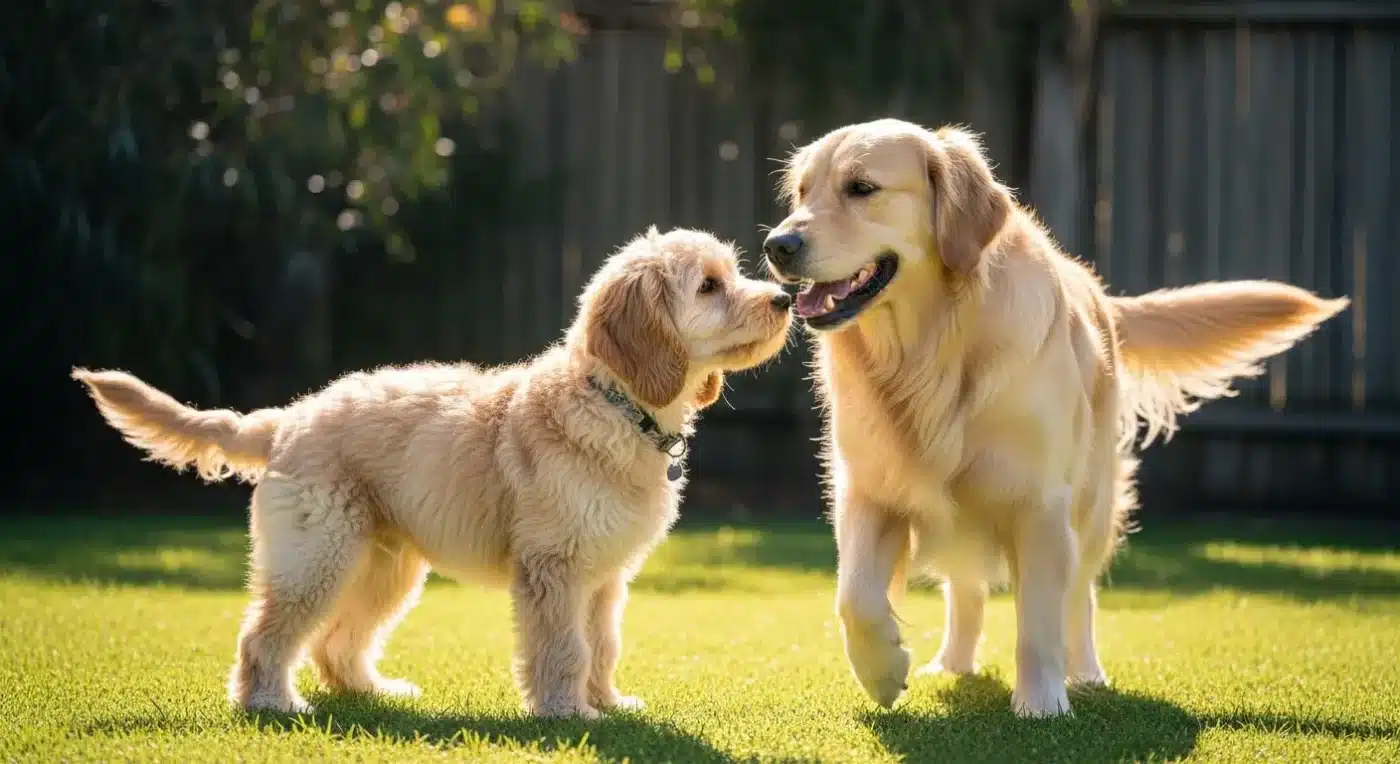
- Meeting other animals (dogs, cats, birds)
- Being handled (paws touched, ears examined, mouth opened, body checked)
The Critical Socialisation Window
This is the most important thing to understand: there’s a window that closes.
The critical period is 3-14 weeks of age.
During this window, puppies are naturally curious and open to new experiences. Their brains are primed to accept new things as “normal.” After about 14 weeks, this window starts closing. Puppies become more cautious and less accepting of unfamiliar things.
The challenge: This window overlaps with the time before your puppy is fully vaccinated (around 16 weeks). Many owners avoid socialisation out of fear of disease. But the behavioural risks of under-socialisation are often greater than the disease risks of careful exposure.
The solution: Socialise smartly. Avoid high-risk areas while maximising safe exposure.
Safe Socialisation Before Full Vaccination
Your puppy isn’t fully protected until 2 weeks after their final vaccination (around 16-18 weeks). But waiting until then to socialise means missing the critical window. Here’s how to balance safety and socialisation:
What’s Safe:
- Your own backyard — Safe if no unvaccinated dogs have been there recently
- Friends’ homes — If their dogs are vaccinated and healthy
- Puppy school — Reputable ones require vaccination proof and clean facilities
- Carrying puppy in public — They can see, hear, and smell without touching the ground
- Car rides — Exposure to motion, sounds, sights
- Your front yard or driveway — Watch the world go by
What to Avoid:
- Dog parks — High disease risk, unvaccinated dogs
- Pet stores — Many dogs pass through
- Footpaths with heavy dog traffic — Parvo can survive in the environment
- Areas where stray dogs may have been
The Carrier/Bag Trick
One of the best socialisation tools is a carrier bag or backpack. You can take your puppy:
- To busy shopping areas
- On public transport
- To outdoor cafes
- Through crowded markets
- Near construction sites
They experience everything without their paws touching the ground. It’s socialisation gold.
Socialisation Checklist: 100 Things in 100 Days
Try to expose your puppy to as many of these as possible during the critical window. Quality matters more than quantity — each experience should be positive.
People (Aim for 20+)
- ☐ Men with beards
- ☐ Men without beards
- ☐ Women
- ☐ Children (supervised, gentle)
- ☐ Elderly people
- ☐ People with glasses/sunglasses
- ☐ People with hats
- ☐ People in uniforms
- ☐ People with walking aids
- ☐ People of different ethnicities
- ☐ People with umbrellas
- ☐ Delivery people
- ☐ People carrying bags/backpacks
- ☐ People on bikes
- ☐ People on skateboards
Animals
- ☐ Vaccinated, friendly adult dogs
- ☐ Puppies (at puppy school)
- ☐ Cats (if possible, safely)
- ☐ Birds
- ☐ Livestock (from a distance if rural)
Environments
- ☐ Busy streets (carried)
- ☐ Quiet suburban streets
- ☐ Parks
- ☐ Beaches
- ☐ Outdoor cafes
- ☐ Shopping centres (carried)
- ☐ Vet clinic (just for visits/treats)
- ☐ Grooming salon (familiarisation)
- ☐ Friend’s houses
- ☐ Cars
- ☐ Inside buildings (pet-friendly)
Surfaces
- ☐ Grass
- ☐ Concrete
- ☐ Tiles
- ☐ Carpet
- ☐ Sand
- ☐ Gravel
- ☐ Metal grates
- ☐ Wooden decking
- ☐ Wet surfaces
- ☐ Stairs
Sounds
- ☐ Vacuum cleaner
- ☐ Hair dryer
- ☐ Thunder (recordings work)
- ☐ Fireworks (recordings)
- ☐ Traffic noise
- ☐ Construction sounds
- ☐ Dogs barking
- ☐ Doorbells
- ☐ Loud music
- ☐ Kitchen sounds
Handling
- ☐ Touching paws
- ☐ Handling ears
- ☐ Looking at teeth
- ☐ Touching tail
- ☐ Touching belly
- ☐ Lifting and holding
- ☐ Gentle restraint
- ☐ Nail clipping (or pretending)
- ☐ Brushing
- ☐ Bathing
How to Socialise Correctly
Exposure alone isn’t enough. The experience needs to be positive. Here’s how:
The Rules
- Start at a distance — If something is scary, observe from far away first
- Use treats — Pair new experiences with high-value treats
- Watch body language — Ears back, tail tucked, whale eye = stressed
- Don’t force it — Let puppy approach at their own pace
- Keep it short — Brief positive experiences are better than long overwhelming ones
- End on a high note — Stop while they’re still happy, not when they’re stressed
- Repeat — One exposure isn’t enough. Multiple positive experiences build confidence.
Signs Your Puppy Is Enjoying It
- Loose, wiggly body
- Wagging tail (relaxed, not stiff)
- Approaching willingly
- Taking treats easily
- Curious sniffing
Signs Your Puppy Is Stressed
- Ears back or flattened
- Tail tucked
- Trying to hide or escape
- Refusing treats
- Whale eye (showing whites of eyes)
- Lip licking, yawning
- Freezing
If you see stress signs, increase distance, slow down, or end the session. Pushing through fear makes things worse.
Socialising with Other Dogs
Dog-dog socialisation is important, but it needs to be done right.
Good Dog Interactions
- With known, vaccinated, friendly dogs
- Supervised and controlled
- With dogs who match your puppy’s energy
- Brief play sessions with breaks
- At puppy school (controlled environment)
Bad Dog Interactions
- Dog parks (unpredictable dogs, disease risk)
- Forcing interaction with unwilling dogs
- Letting big dogs overwhelm your puppy
- Letting your puppy be bullied
- No supervision or intervention
Quality Over Quantity
It’s better to have 5 positive dog interactions than 20 chaotic ones. One bad experience with a scary dog can create lasting fear.
Puppy School: Is It Worth It?
Yes. Good puppy schools provide:
- Controlled socialisation with other puppies
- Basic training foundations
- Exposure to new environments and people
- Professional guidance
- Questions answered by trainers
What to Look For
- Requires vaccination proof from all puppies
- Clean facilities
- Small class sizes
- Positive reinforcement methods (no punishment, no dominance theory)
- Qualified trainer
- Puppies grouped by size/age
When to Start
Most puppy schools accept puppies from 10-12 weeks (after second vaccination). This is perfect timing for the critical window.
Socialisation at Home
You can do a lot without leaving the house:
Sound Desensitisation
- Find recordings of thunder, fireworks, traffic, etc. (YouTube has plenty)
- Play at very low volume during positive activities (eating, playing)
- Gradually increase volume over days/weeks
- Never force exposure to scary sounds
Handling Exercises
- Every day, briefly handle paws, ears, mouth, tail
- Pair with treats
- Mimic vet and groomer handling
- Keep sessions short and positive
Visitors
- Invite different people over
- Ask them to give your puppy treats
- Include people wearing hats, carrying bags, etc.
- Keep visits calm and positive
What If You Missed the Window?
If you adopted an older puppy or weren’t able to socialise during the critical period, it’s not too late — but it’s harder.
- Go slower — Older dogs are more cautious; respect their pace
- Use counter-conditioning — Pair scary things with high-value treats at a distance
- Work with a professional — A qualified behaviourist can help with specific fears
- Be patient — Progress may be slow, but improvement is possible
Common Socialisation Mistakes
- Waiting until fully vaccinated — Misses the critical window
- Forcing interactions — Creates negative associations
- Flooding — Too much, too fast overwhelms the puppy
- Ignoring stress signals — Pushes puppy over threshold
- Not using treats — Experiences should be paired with rewards
- Relying only on dog parks — Uncontrolled, risky, can backfire
- Thinking socialisation ends — It should continue throughout adolescence
Cavoodles and Socialisation
Cavoodles are generally friendly, adaptable dogs — which makes socialisation easier. But they can still develop fears if not properly exposed.
Cavoodle-specific tips:
- They’re small — protect them from overwhelming big dogs
- They bond strongly — may be wary of strangers if not exposed early
- They’re smart — pick up on your anxiety, so stay calm
- They need grooming — early groomer visits are essential socialisation
Final Thoughts
The effort you put into socialisation during the first few months pays off for your dog’s entire life. A well-socialised Cavoodle is confident, calm, and a joy to take anywhere.
Don’t let vaccination fears hold you back — there are plenty of safe ways to expose your puppy to the world. Use the checklist, follow the rules, and watch your puppy become a confident companion.
For everything else about raising a Cavoodle puppy, check out our complete guide to preparing for a Cavoodle puppy.

Written by Marine Ponchaut
Marine is the founder of WoofSpark, a professional dog grooming salon in Cessnock, NSW. Since founding WoofSpark in 2019, she has groomed thousands of dogs — including countless Cavoodles, one of Australia’s most popular breeds.
Socialisation Golden Rules
- 3-14 weeks is the critical window — don’t waste it
- Quality over quantity
- Watch body language
- Never force interactions
- Use treats to create positive associations
- Carry puppy to experience the world safely