
Breed Guides
Groodle Grooming Guide: How to Care for Your Goldendoodle’s Gorgeous Coat
Jan

Groodles—or Goldendoodles, as they’re known internationally—are the gentle giants of the doodle world. Cross a Golden Retriever with a Poodle and you get one of the most affectionate, patient dogs you’ll ever meet. You also get a coat that requires serious commitment.
That beautiful golden fluff? It shows everything. Mud, leaves, breakfast remnants from their beard—Groodles are magnets for mess. And with their larger size comes more coat to maintain.
At WoofSpark, we’ve groomed thousands of Groodles over the years. We’ve seen coats in perfect condition and coats that needed a full rescue mission. This guide shares everything we know about keeping your Groodle looking gorgeous between professional grooms.
What Makes Groodle Coats Different
Groodles inherit their coat from two very different parents. Understanding this mix helps you understand the maintenance required.
The Golden Retriever Influence
Golden Retrievers have a double coat—a longer outer layer and a dense undercoat. They’re moderate to heavy shedders. Their coat is designed to repel water and handle outdoor conditions.
The Poodle Influence
Poodles have a single-layer, continuously growing coat that barely sheds. It’s curly, dense, and prone to matting if not maintained.
What Your Groodle Gets
The result is unpredictable. Your Groodle might inherit:
- A curly, non-shedding coat (more Poodle)
- A wavy, low-shedding coat (the typical “doodle” look)
- A straighter coat that sheds more (more Retriever)
Puppies from the same litter can have completely different coats. Even breeders can’t predict exactly what you’ll get. You find out as the adult coat develops between 6-12 months.
The Three Groodle Coat Types
After grooming thousands of Groodles, we classify their coats into three main types:
Wool Coat (Tight Curls)
Characteristics:
- Looks most like a Poodle coat
- Dense, tight curls
- Little to no shedding
- Highest maintenance of all coat types
Grooming Requirements:
- Daily brushing (no exceptions)
- Professional grooming every 4-6 weeks
- Mats within 3-4 days without brushing
- Most likely to need dematting if neglected
Fleece Coat (Soft Waves)
Characteristics:
- The most common Groodle coat type
- Soft, flowing waves (the classic “doodle look”)
- Low to moderate shedding
- Medium maintenance
Grooming Requirements:
- Brushing every 2-3 days (daily is better)
- Professional grooming every 6-8 weeks
- Mats within 5-7 days without brushing
- More forgiving than wool, but still needs attention
Hair Coat (Mostly Straight)
Characteristics:
- Resembles the Golden Retriever parent more
- Straighter texture with possible undercoat
- Higher shedding than other types
- Lower maintenance for matting
Grooming Requirements:
- Brushing 2-3 times weekly
- Professional grooming every 8-10 weeks
- Less prone to matting but sheds more
- Still needs regular attention
How to Identify Your Groodle’s Coat Type
The Wet Test:
Get your Groodle wet and watch what happens as the coat dries:
- Springs into tight ringlets → Wool coat
- Forms loose, flowing waves → Fleece coat
- Hangs mostly straight with some wave → Hair coat
The Feel Test:
Run your fingers through the coat:
- Dense and springy → Wool
- Soft and silky → Fleece
- Coarser with possible undercoat → Hair
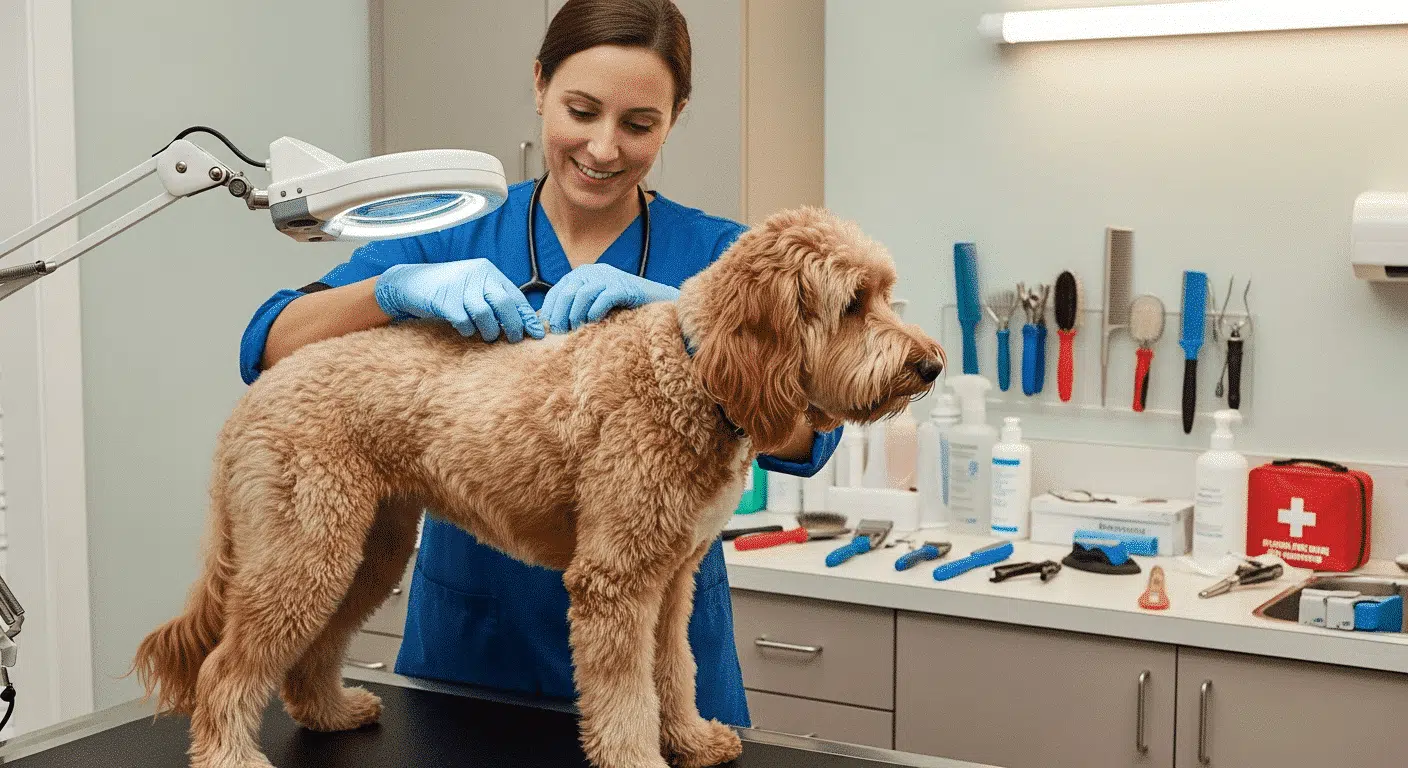
Essential Grooming Tools for Groodles
Groodles are bigger dogs with bigger coats. That means you need tools that can handle the job.
Must-Have Tools
Slicker Brush (Large)
The most important tool you’ll own. For Groodles, invest in a larger brush with flexible pins. You’ll be brushing more surface area, and a tiny brush makes the job tedious. We recommend brushes designed for medium to large curly-coated breeds.
Metal Comb (Greyhound Comb)
Your quality control tool. After brushing, run the comb through the coat. If it glides through, you’re done. If it catches, there’s more brushing to do. This step catches hidden mats that brushing missed.
Detangling Spray
Never brush a dry Groodle coat. Detangling spray adds slip, reduces static, and makes brushing more comfortable for your dog. Spray lightly before each session.
Dematting Tool
For working through tangles before they become solid mats. Use gently—the goal is to separate, not rip through.
Rounded-Tip Scissors
For trimming around eyes, paws, and sanitary areas between professional grooms. The rounded tips prevent accidents if your Groodle moves unexpectedly.
The Groodle Size Factor
Because Groodles are larger dogs (typically 20-35kg), grooming takes longer than their smaller Cavoodle cousins. Budget extra time and make sure your tools are sized appropriately.
A slicker brush designed for a Cavoodle will technically work on a Groodle—but you’ll be there all day.
How Often to Groom Your Groodle
Consistency is everything. Here’s what we recommend:
Brushing Frequency by Coat Type
| Coat Type | Minimum | Recommended |
|---|---|---|
| Wool | Daily | Daily |
| Fleece | Every 2-3 days | Every other day |
| Hair | Every 3-4 days | Every 2-3 days |
The Golden Coat Reality
Groodles—especially those with golden or cream coats—show dirt like nobody’s business. That gorgeous golden fluff turns brown after one muddy walk. The beard collects food and water. Leaves stick to them like velcro.
This means:
- More frequent spot-cleaning
- Regular beard washing
- Quick brushes after outdoor adventures
- Acceptance that they’ll rarely stay pristine for long
Professional Grooming Schedule
| Coat Type | Frequency |
|---|---|
| Wool | Every 4-6 weeks |
| Fleece | Every 6-8 weeks |
| Hair | Every 8-10 weeks |
If you’re finding mats between appointments, either increase your home brushing or book more frequently. Don’t wait until the next scheduled appointment if the coat is getting out of control.
The Complete Brushing Technique
Here’s how professional groomers actually brush a Groodle—not just the surface, but properly.
Line Brushing Method
Surface brushing is the most common mistake we see. Owners run a brush over the top of the coat, see it glide through, and think they’re done. Meanwhile, mats are forming at the skin level.
The Proper Technique:
- Spray with detangling spray — Light mist over the section you’re about to brush
- Part the coat horizontally — Use your free hand to hold the coat above where you’re brushing
- Brush from skin to tip — Start at the skin and brush small sections outward
- Work in lines — Move up the body systematically, parting and brushing each section
- Check with the comb — Run a metal comb through each area. If it catches, you missed something.
The Groodle Trouble Spots
These areas mat first. Check them every single time:
Behind the Ears
Fine hair that tangles quickly. Easy to miss because it’s hidden by the ear flap.
Under the Collar/Harness
Friction from walking creates mats. Remove collar and harness during brushing.
Armpits
The #1 matting spot on any doodle. Hidden, often forgotten, frequently severely matted by the time we see them.
Groin and Inner Thighs
Friction zone. Part the fur and check—these mats hide well.
Chest and Belly
Soft hair that tangles easily, especially on Groodles who love lying on the floor.
The Beard
Food, water, dirt—it all collects here. Brush and wash regularly to prevent clumping and odour.
The “Pantaloons” (Back Legs)
Those fluffy back legs look gorgeous but mat easily. Don’t skip them.
How Long Should Brushing Take?
For a standard-sized Groodle:
- Quick maintenance brush: 15-20 minutes
- Thorough session: 30-45 minutes
- Post-swim or muddy adventure: Add 20+ minutes
If you’re finishing in 5 minutes, you’re not brushing thoroughly.
Bathing Your Groodle
Before You Bathe: The Critical Step
Always brush first. This is non-negotiable.
Wet mats tighten. Water acts like glue, making mats nearly impossible to remove without cutting. If you bathe a matted Groodle, you’re guaranteeing a shave-down.
If you find mats while preparing to bathe, work them out first—or call your groomer.
Bathing Steps
- Thorough brush and comb — Remove all tangles before water touches the coat
- Wet the coat completely — Groodle coats are dense. It takes time to saturate fully. Be patient and work the water through.
- Apply shampoo — Use a quality dog shampoo. Work it through the entire coat, including the legs, belly, and beard.
- Rinse completely — Residue causes itching and coat dullness. Rinse longer than you think necessary.
- Condition (optional but helpful) — Makes brushing easier and adds softness
- Final rinse — Until water runs completely clear
Drying: Don’t Skip This
Never air dry a Groodle. Their dense coat stays damp for hours, creating perfect conditions for:
- Hot spots and skin infections
- That lingering wet dog smell
- Mats forming as the coat dries tangled
Best option: High-velocity dryer. This is what professionals use. It blasts water out and separates the coat.
Home option: Regular blow dryer on cool setting. Keep it moving to avoid heat damage. This takes significantly longer on a Groodle-sized dog.
Crucial: Brush while drying. This prevents tangles from forming as the coat dries.
Common Groodle Coat Problems
Matting
The most common issue we see. By far.
Why it happens:
- Infrequent brushing (the #1 cause)
- Surface-only brushing (missing the base layer)
- Moisture without proper drying (swimming, rain)
- Friction (collars, harnesses, lying down)
- Coat transition from puppy to adult
Prevention:
- Brush properly using line brushing technique
- Check trouble spots every session
- Dry completely after getting wet
- Remove collar/harness while brushing
What to do when you find mats:
- Small tangles: Spray with detangler, hold at base, gently work through
- Larger mats: Use mat splitter to separate, then brush out
- Severe matting: See a professional. Attempting to brush out painful mats is cruel—shaving is often the kindest option.
The Muddy Groodle Problem
Groodles love water. Many love mud even more. And that golden coat shows every speck of it.
Solutions:
- Quick rinse after muddy adventures
- Dry thoroughly (wet + dirty = mat central)
- Keep a towel by the door
- Consider a shorter clip if they’re constantly mud-diving
- Accept that they’ll never stay clean for long
Smelly Beard
That adorable Groodle beard collects food, water, and drool. Left uncleaned, it starts to smell.
Solutions:
- Wipe beard after meals
- Wash beard separately between full baths
- Keep beard trimmed if odour persists
- Check for underlying skin issues if smell is severe
Grooming Through the Seasons (Australian Climate)
Summer (December – February)
Challenges:
- Swimming season (wet coat management)
- Beach visits (salt and sand damage)
- Heat under heavy coat
- Hot spots from humidity
What to do:
- Book a summer clip (shorter cut for comfort)
- Rinse thoroughly after swimming
- Dry completely every time
- Check for grass seeds in paws and ears
- Watch for hot spots (red, moist patches)
Autumn (March – May)
Challenges:
- Coat starts thickening
- Leaves and debris stick to coat
- Grass seeds still around
What to do:
- Good time to let coat grow slightly
- Increase brushing as coat thickens
- Continue checking for debris after walks
- Book groom before coat gets too thick
Winter (June – August)
Challenges:
- Fuller coat tangles more easily
- Wet weather creates muddy dogs
- Owners assume less grooming needed
What to do:
- Maintain brushing frequency (winter coats mat too)
- Dry thoroughly after wet walks
- Consider a belly clip for mud management
- Don’t skip professional grooms
Spring (September – November)
Challenges:
- Winter coat may blow out
- Grass seeds everywhere
- Allergy season
What to do:
- Increase brushing frequency
- Check for grass seeds after every walk
- Book pre-summer groom
- Watch for allergy-related skin issues
Groodle Grooming Styles
Groodles can carry many different looks. Here are the most popular:
The “Teddy Bear” Cut
What it looks like: Medium length all over (1-2 inches), round face, fluffy ears
Maintenance required: High. Needs consistent brushing to prevent matting.
Best for: Owners committed to regular brushing who love the classic doodle look.
The “Puppy Cut”
What it looks like: Shorter version of the teddy bear. Even length all over (1/2 – 1 inch).
Maintenance required: Moderate. Still needs brushing but more forgiving.
Best for: Active dogs, busy owners, hot weather.
The Short Clip
What it looks like: Short all over (under 1/2 inch).
Maintenance required: Low. Minimal home brushing needed.
Best for: Owners who struggle to keep up with brushing, very active dogs, hot climates.
Pro tip: There’s no shame in keeping your Groodle short. A well-maintained short coat is far better than a long coat full of mats. Be honest about your brushing commitment and choose a style you can actually maintain.
The Groodle Temperament Advantage
Here’s the good news about grooming a Groodle: they’re usually wonderful to work with.
That Golden Retriever influence means most Groodles are:
- Patient during grooming
- Tolerant of handling
- Eager to please
- Not dramatic about brushing
Many Groodles actually enjoy grooming time—it’s attention from their favourite human.
If your Groodle is anxious about grooming, it’s often because they had a bad experience (painful dematting, for example). Building positive associations with treats and patience usually helps.
When to See a Professional Groomer
Home grooming is essential, but it doesn’t replace professional care. Book an appointment when:
- It’s been 6-8 weeks (or 4-6 for wool coats)
- You feel mats forming — Better early than severe
- The coat looks unkempt — Sometimes you need a reset
- Eyes are blocked by hair — Safety issue
- Nails are clicking — If you’re not doing this yourself
- Ears smell or look irritated — Professional cleaning needed
- You’re overwhelmed — That’s what we’re here for
What to Expect at a Professional Groom
A full Groodle groom typically includes:
- Bath with appropriate shampoo and conditioner
- Blow dry (high-velocity)
- Full brush and demat
- Haircut to your preferred style
- Face, feet, and sanitary trim
- Ear cleaning
- Nail trim
- Cologne
Time required: 2-3 hours depending on coat condition and style. Groodles are big dogs—they take longer than their smaller doodle cousins.
The Bottom Line
Groodles are beautiful dogs with beautiful coats—but those coats need commitment. The equation is simple:
Regular brushing + proper technique + professional maintenance = gorgeous, healthy coat
Skipped brushing + surface-only technique + delayed appointments = mats, shave-downs, and disappointed owners
The Groodle owners who succeed are the ones who:
- Understand their specific dog’s coat type
- Brush properly and consistently
- Use quality tools
- Dry thoroughly after swimming and baths
- Work with a professional groomer regularly
- Accept that these dogs aren’t low maintenance
If you commit to the care, you’ll be rewarded with a stunning, mat-free Groodle. If you can’t commit to regular brushing, keep them in a shorter clip that’s more forgiving.
Your Groodle’s coat is worth the effort. And honestly? So is the quality time brushing together.
Have questions about your Groodle’s coat? Reach out—we love helping fellow Groodle owners.
Related Reading
Continue exploring our grooming guides:
- Poochon Grooming Guide: Expert Coat Care
- Irish Doodle Grooming Guide: Expert Coat Care
- Yorkipoo Grooming Guide: Expert Coat Care Tips
Ready to book a professional grooming session? Book your appointment or view our services.
Your Groodle Deserves to Be Art
We’ve groomed thousands of Groodles — and every single one has a face worth framing. Upload a photo, pick your style, and we’ll turn your dog into a custom portrait. 10 styles. From $29. Ready in minutes.
See Your Groodle as a Portrait