
Puppy Guide
How to House Train a Puppy in Australia: The Complete Guide
Feb
House training a puppy isn’t complicated. It’s repetitive, it requires patience, and there will be accidents—but the actual process is straightforward once you understand how puppies work.
🎯 Quick Answer
House training takes 4-8 weeks with consistent effort. Take your puppy outside every 1-2 hours, after meals, after naps, and after play. Use enzymatic cleaner for accidents (regular cleaners don’t remove the smell dogs detect). Never punish accidents — it teaches them to hide, not to hold. Most puppies sleep through the night by 12-16 weeks.
The problem with most house training guides is they’re written by people who’ve never cleaned puppy wee off carpet at 3am. They give you theory without telling you what to actually do when your puppy squats on your rug mid-sentence.
We’ve talked to thousands of puppy owners through our grooming salon. We know the real questions: How long will this actually take? What do I do when they have an accident inside? Why do they keep going in the same spot? Is my puppy broken?
This guide answers all of it.
How Puppies Actually Learn
Before we get to the schedule, you need to understand one thing: puppies don’t know the difference between inside and outside. To them, the whole world is a toilet.
Your job isn’t to punish them for going inside. Your job is to:
- 1. Take them outside so often that they mostly go outside
- 2. Reward them heavily when they do
- 3. Make inside less appealing (through cleaning, not punishment)
💡 Marine’s Pro Tip
In the salon, I chat with hundreds of puppy owners. The ones who house train fastest aren’t the most experienced — they’re the most consistent. Same spot outside, same schedule, same praise every single time. Puppies learn patterns, not exceptions.
That’s it. That’s the entire strategy.
Puppies have tiny bladders and limited control. An 8-week-old puppy can hold their bladder for about 2 hours maximum during the day—and often less when excited or after eating. Expecting them to “hold it” longer isn’t training, it’s setting them up to fail.
The House Training Schedule
This schedule works for most puppies. Adjust based on your puppy’s age and individual needs.
When to Take Your Puppy Outside
Take them out:
- First thing in the morning — The moment they wake up, straight outside. Don’t stop to make coffee.
- After every meal — 15-20 minutes after eating
- After every nap — Even short ones
- After play sessions — Excitement = need to wee
- Before bed — Last thing at night
- Every 1-2 hours in between — Yes, really. More often for younger puppies.
The Routine
- 1. Take them to the same spot every time. Residual scent encourages them to go.
- 2. Use a cue word. Say “go toilet” or “do your business” (whatever you’re comfortable saying in public) while they’re going. Eventually, they’ll associate the word with the action.
- 3. Wait quietly. Don’t play with them or give attention until they’ve done their business. Stand still, be boring.
- 4. Praise immediately when they go. The moment they finish, praise them warmly. Give a treat if you want faster results. The reward needs to happen within 2 seconds of them finishing.
- 5. Then play or walk. Going outside should be about toileting first, fun second.
Sample Schedule for an 8-12 Week Old Puppy
| Time | Action |
|---|---|
| 6:00am | Wake up → immediately outside |
| 6:15am | Breakfast |
| 6:30am | Outside again (post-meal) |
| 8:00am | Outside (2-hour check) |
| 9:00am | Nap time in crate/pen |
| 10:00am | Wake from nap → outside |
| 10:30am | Play time |
| 11:00am | Outside (post-play) |
| 12:00pm | Lunch |
| 12:20pm | Outside (post-meal) |
| 1:00pm | Nap time |
| 2:30pm | Wake from nap → outside |
| 3:00pm | Play/training |
| 3:30pm | Outside |
| 5:00pm | Dinner |
| 5:20pm | Outside (post-meal) |
| 6:30pm | Outside |
| 8:00pm | Outside |
| 9:30pm | Last toilet break → bed |
💡 Marine’s Pro Tip
I always ask new puppy owners about their house training progress because it tells me about routine and consistency at home. Puppies who are still having lots of accidents at 6 months often have other training gaps too. If house training is stalling, go back to basics — more frequent outside trips, not punishment.
This might look excessive. It is. But it’s temporary. The more often you take them out in the beginning, the faster they learn.
Week-by-Week Progress
Every puppy is different, but here’s what typical progress looks like.
Week 1-2: Building the Habit
What to expect:
- Lots of accidents
- They don’t understand what you want yet
- You’ll feel like nothing is working
What you’re actually doing:
- Creating the routine
- Learning your puppy’s signals
- Building the association between outside and toileting
Success at this stage: They go outside when you take them. That’s it. Don’t expect them to ask yet.
Week 3-4: Recognition
What to expect:
- Fewer accidents (but still some)
- They might start going to the door
- You’ll notice patterns in when they need to go
What you’re actually doing:
- They’re starting to understand that outside is the toilet place
- You’re getting better at anticipating their needs
Success at this stage: Most toileting happens outside when you’re consistent with the schedule.
Week 5-8: Reliability Begins
What to expect:
- Accidents become rare
- They may start signalling (going to door, circling, sniffing)
- Longer periods between toilet breaks
What you’re actually doing:
- Building bladder control
- Reinforcing the habit
Success at this stage: They actively try to go outside. Accidents are occasional, not daily.
Month 3-6: Consolidation
What to expect:
- Rare accidents (maybe when excited or routine disrupted)
- Can hold longer between breaks
- Clear signals when they need to go
When to consider them “house trained”:
- No accidents for 4+ weeks
- Actively signals when needing to go
- Can hold through the night
💡 Marine’s Pro Tip
The puppies who come to us well house-trained are also the easiest to groom. Why? Because their owners established routine and patience early. House training is really teaching your puppy to trust your guidance — that skill transfers to everything else.
Night Time Training
Puppies under 12 weeks often can’t hold through the night. You have two options:
Option 1: Crate Training (Recommended)
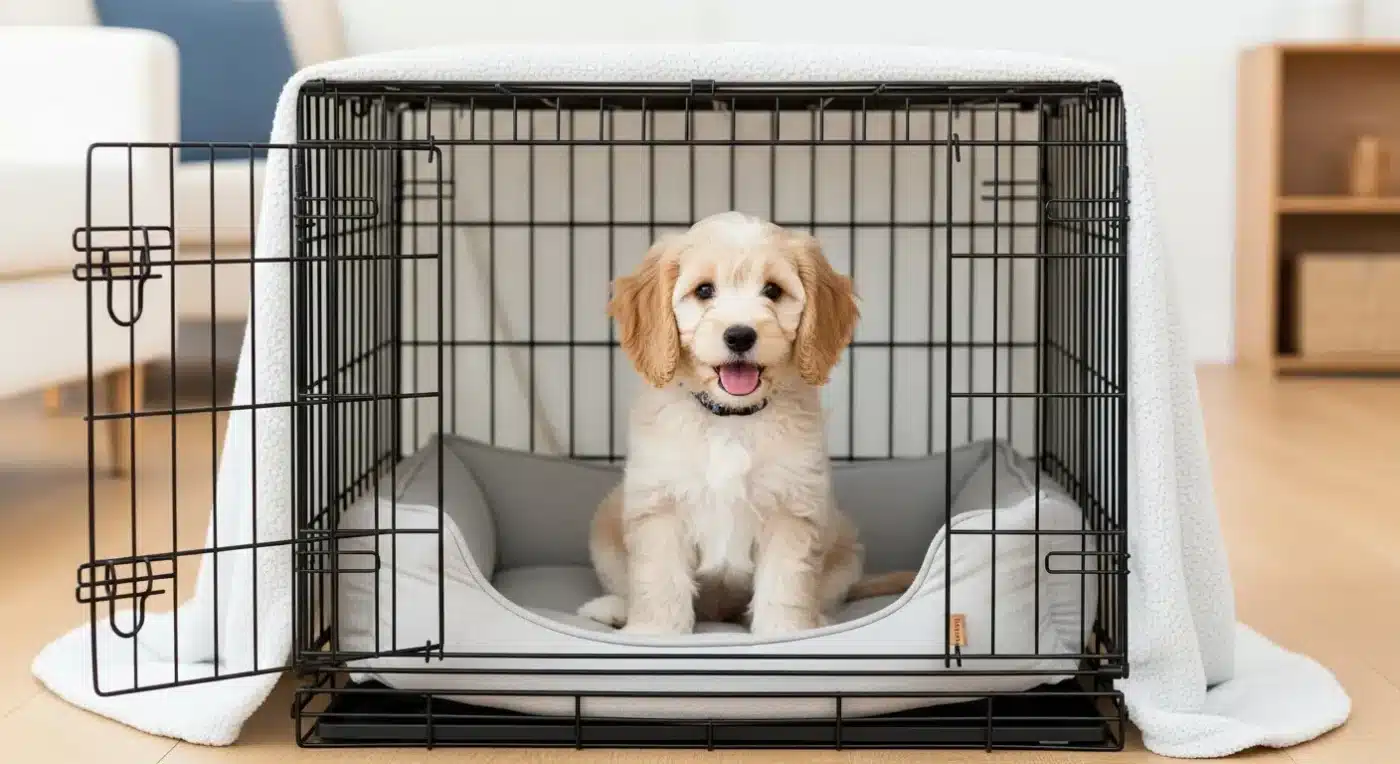
Puppies don’t like to toilet where they sleep. A properly-sized crate uses this instinct.
- Crate should be big enough to stand, turn around, and lie down—no bigger
- Puppy sleeps in crate beside your bed
- When they cry/whine, take them straight outside (no playing, no talking)
- Toilet, praise, back to crate
Most puppies can sleep through by 12-16 weeks with this method.
Option 2: Puppy Pads in Confined Area
If crate training isn’t working:
- Confine puppy to small area (playpen)
- Put bed at one end, puppy pads at the other
- They’ll naturally toilet away from their bed
- Gradually reduce pad area as they get older
Note: This can slow down outdoor training because you’re teaching them it’s okay to go inside (on pads). We recommend crate training if possible.
When to Set an Alarm
For puppies under 10 weeks:
- Set alarm for 3-4 hours after bedtime
- Take them out, toilet, back to bed
- Gradually extend the time between breaks
By 12-14 weeks, most puppies can make it 6-7 hours.
What to Do When Accidents Happen
Accidents will happen. How you respond matters.
If You Catch Them Mid-Accident
- 1. Interrupt with a sharp “ah-ah” or clap (not yelling)
- 2. Pick them up immediately (they’ll usually stop)
- 3. Take them outside to their toilet spot
- 4. Wait for them to finish
- 5. Praise when they do
If You Find an Accident After the Fact
- 1. Don’t react to the puppy at all
- 2. Clean it up thoroughly (see below)
- 3. Move on
Puppies can’t connect punishment to something they did even 30 seconds ago. Rubbing their nose in it, scolding them, or showing them the mess does nothing except make them scared of you. They don’t understand why you’re angry.
How to Clean Up Properly
This is more important than most people realise.
Why it matters: Dogs can smell traces of urine that humans can’t detect. If they can still smell it, they’ll keep going in that spot.
What to use:
- Enzymatic cleaner — This is essential. Regular cleaners don’t break down the proteins in urine that dogs can smell. BioPet, Rufus & Coco, and Urine Off are good Australian options.
- Not ammonia-based cleaners — Urine contains ammonia. Cleaning with ammonia actually attracts dogs back to the spot.
How to clean:
- 1. Blot up as much as possible with paper towels
- 2. Apply enzymatic cleaner according to instructions
- 3. Let it soak (usually 10-15 minutes)
- 4. Blot again
- 5. Allow to air dry
- 6. Repeat if needed
For carpet, you may need to soak through to the underlay. Old accidents may need multiple treatments.
Common House Training Problems
“They Keep Going in the Same Spot”
The spot probably still smells like a toilet to them, even if it smells clean to you.
Solution:
- Deep clean with enzymatic cleaner (may need multiple applications)
- Block access to that area temporarily
- Put their food bowl there (dogs don’t toilet where they eat)
“They Go Inside Right After Coming Inside”
This is frustrating but common. Usually means:
- They got distracted outside and didn’t fully empty
- They’re excited to be back inside
- They didn’t have enough time outside
Solution:
- Stay outside longer (10-15 minutes)
- Walk around slowly—movement helps
- Don’t let them play outside until after they’ve toileted
- Watch them closely for 10-15 minutes after coming inside
“They Only Have Accidents When I’m Not Watching”
They’ve learned that toileting in front of you leads to being interrupted or moved. They wait until you’re not looking.
Solution:
- Supervise constantly when inside (tether them to you if needed)
- Use a crate or playpen when you can’t supervise
- Never punish accidents—this makes hiding worse
“They Were Doing Great, Then Started Having Accidents Again”
Regressions happen. Common causes:
- Change in routine
- New environment
- Illness (always worth a vet check)
- Growth spurt (bodies change faster than habits)
- Excitement or stress
Solution:
- Go back to basics—more frequent toilet breaks
- Increase supervision
- Rule out medical issues
- Be patient—it usually resolves within a week or two
“My Puppy Is 6 Months Old and Still Having Accidents”
Some possibilities:
- Medical issue (UTI, diabetes—see your vet)
- Incomplete training (too much freedom too soon)
- Submissive urination (different issue, requires different approach)
- Marking (if not desexed)
Solution:
- Vet check first
- Strip back freedom—crate when unsupervised
- Return to frequent toilet schedule
- Consistent enzyme cleaning of accident spots
Breed Considerations
Some breeds are genuinely harder to house train than others. Small breeds often take longer because:
- Tiny bladders with less capacity
- Faster metabolisms
- Accidents are smaller and easier to miss (less consequence)
- Owners often give them more indoor freedom
If you have a small breed (Cavoodle, Maltese, Chihuahua, etc.), expect the process to take a bit longer. Be extra consistent with the schedule.
The Role of Diet
What goes in affects what comes out.
Consistent feeding times = predictable toilet times. Free-feeding (leaving food out all day) makes house training harder because you can’t predict when they’ll need to go.
Quality food = firmer, less frequent stools. Cheap food often leads to more frequent, looser bowel movements.
Don’t change food suddenly during house training. Dietary changes cause digestive upset, which causes accidents.
Puppy Pads: Help or Hindrance?
Puppy pads are controversial. Here’s the honest take:
When pads make sense:
- Apartments without quick outdoor access
- Elderly or mobility-limited owners
- Extreme weather (Australian summers, storms)
- Very young puppies (under 8 weeks)
The downside:
- You’re teaching them it’s okay to toilet inside
- Transitioning from pads to outdoor-only can be confusing
- Some puppies generalise “soft surface = toilet” (including rugs, towels, beds)
If you use pads:
- Gradually move them closer to the door
- Then move them outside
- Then remove them entirely
- Be patient—this transition takes weeks
Our recommendation: If you can avoid pads, do. If you need them, plan the transition from the start.
When to Seek Help
Most house training challenges are solved with consistency and time. But sometimes you need professional help.
See your vet if:
- Sudden increase in accidents in a previously trained dog
- Excessive drinking and urination
- Straining to urinate or blood in urine
- Dribbling urine while sleeping
- Accidents only happen overnight (could be medical)
Consider a trainer if:
- Your puppy is over 6 months with no progress
- They show fear or anxiety around toileting
- You’re feeling frustrated and need support
- There are other behavioural issues involved
The Mindset Shift
House training is not about teaching your puppy not to go inside. It’s about teaching them that outside is where good things happen.
Every time they toilet outside, they’re learning that outside is the right place. Every accident inside (that you don’t catch) is a missed opportunity, but it’s not a failure.
The puppies who house train fastest aren’t the smartest—they’re the ones whose owners were most consistent. Consistency matters more than any trick or technique.
Take them out often. Praise when they go. Clean accidents properly. Don’t punish.
That’s it. That’s the whole system.
Download: House Training Schedule PDF
We’ve created a printable toilet training schedule with tracking sheets so you can log when your puppy goes and spot patterns.
[Download: House Training Schedule PDF]
Related Guides
- New Puppy Checklist Australia — Everything you need before they arrive
- Cavoodle Puppy Checklist — Breed-specific guide
- Your Puppy’s First Week — Day-by-day schedule
- Crate Training Your Puppy — Coming soon
About WoofSpark
We’re professional dog groomers in Cessnock, NSW. We’ve talked to thousands of puppy owners and heard every house training question you can imagine.
This guide is based on what actually works—not theory, but real results from real Australian puppy owners.
If your puppy ever needs professional grooming, we’re here. But this guide is free whether you visit us or not.
Final Notes
Word count: ~3,000 words
Internal links to add:
- /new-puppy-checklist-australia/
- /cavoodle-puppy-checklist/
- /book
- /crate-training-puppy/ (T-series when published)
PDF to create: T2 – House Training Schedule PDF
Featured image: Puppy sitting by door looking expectant, or puppy on grass in garden setting
Schema markup: Article + HowTo (for the schedule section) + FAQ (from problems section)
Publishing notes:
- 1. Upload to WordPress (not Vercel)
- 2. Set featured_media
- 3. Update AIOSEO via MySQL
- 4. Link to related content

Written by Marine Ponchaut
Marine is the founder of WoofSpark, a professional dog grooming salon in Cessnock, NSW. Since founding WoofSpark in 2019, she has groomed thousands of dogs and helped countless new puppy owners get started on the right foot.
Patience Pays Off
House training is temporary — the bond you build while doing it lasts forever. If your puppy needs professional grooming once they’re fully vaccinated, we’re here to help. Book a puppy groom.